Emergency tree removal in Jacksonville is available 24/7, with crews often on site within a few hours. Expect roughly $500–$3,000+ for storm work depending on size, access, and whether a crane is needed. When a storm-felled tree hits an insured structure, homeowners insurance usually covers removal — and every emergency job includes photos and a written estimate for your claim.
When a live oak comes through the roof at 2 a.m. or a pine drops across the only way out of your driveway, you don't need a week of quotes — you need a real crew now. 904 Tree Service keeps the phone answered around the clock and routes your job to a licensed, insured Jacksonville tree crew equipped for exactly this: bucket trucks, cranes, and the rigging experience to lift weight off a structure without making the damage worse.
What counts as a tree emergency
If any of these describe your situation, treat it as an emergency and call right away rather than waiting for a scheduled estimate:
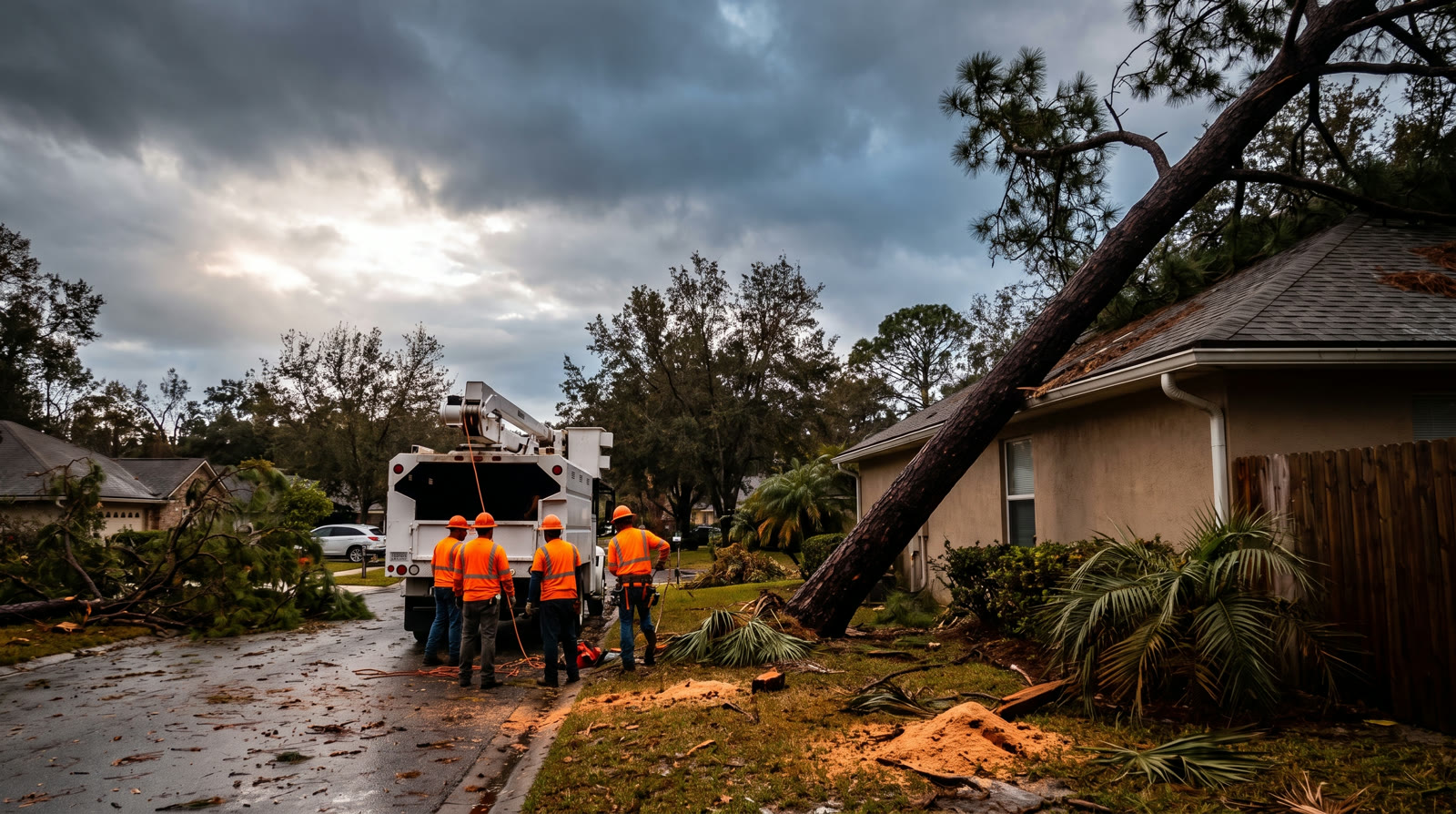
- A tree or large limb on your house, garage, or fence — weight on a roof keeps shifting and can turn a repairable hole into a collapse.
- A trunk or canopy blocking your driveway or the road — you can't get out, or emergency vehicles can't get in.
- A leaning tree or hanging "widow-maker" limb after high wind, especially over a driveway, walkway, or where children play.
- A tree tangled in power lines — the most dangerous of all. Call JEA and 911 first; the utility must de-energize the line before any crew can safely work.
- A split trunk or lifted root plate — the ground heaving up on one side means the tree is already failing.
Why Jacksonville needs 24/7 tree crews
This is a city built under a canopy of enormous live oaks and slash pines, and it sits squarely in the hurricane belt. From June through November, tropical storms and afternoon squalls drop limbs and topple shallow-rooted trees without warning — and Jacksonville's sandy, easily saturated soil lets big trees lean and fall in wind that a clay-anchored tree would shrug off. After named storms like Irma, Matthew, and the systems that have raked the First Coast in recent seasons, thousands of trees come down across Duval, Clay, St. Johns, and Nassau in a single night. That's exactly when owner-operated shops are booked solid and the answered phone wins.
For typical prices on every service — removal, trimming, stumps, palms and storm work — see the full Jacksonville tree service cost guide.
How an emergency call works
The goal is to make the hazard safe first, then finish the full job:
- Call and describe it. Tell us what's down, where it's resting, and whether a line, a structure, or an exit is involved. That tells the crew what equipment to roll.
- Rapid dispatch. A licensed, insured crew is routed to you. Active life-safety hazards — a tree on an occupied house — are prioritized ahead of yard-only debris.
- Make-safe, then clear. The crew stabilizes and removes the weight threatening your home, using a crane where access demands it, then cuts the tree down and clears it.
- Document for insurance. You get dated photos and a written, itemized estimate — the paperwork your adjuster will ask for.
- Full cleanup. Limbs, logs, and debris hauled away; stump grinding available so you're not left with a reminder in the yard.
The first hour after you call
Storm response moves fast when the process is clear. Here's the typical timeline for a Jacksonville emergency call:
- Minutes 0–5 — the call. A live person takes the details: what fell, what it's resting on, whether power lines or an occupied room are involved. If a line is down, you're told to call JEA and 911 first.
- Minutes 5–20 — dispatch. Your job is matched to the nearest licensed, insured crew with the right equipment — a bucket truck for hangers, a crane for a tree on the house — and you get a realistic arrival window, not a guess.
- First hour — make-safe begins. In normal conditions the crew is often rolling within the hour. On arrival they walk the scene, photograph everything for your insurance claim, and start removing the weight that's threatening the structure.
- After a named storm the whole city calls at once. Active life-safety hazards jump the line; yard debris waits. Calling immediately — even mid-storm — holds your place on the board.
What does emergency tree removal cost?
Most Jacksonville storm and emergency work lands between $500 and $3,000+, with the same drivers as planned work: tree size, what it's resting on, and access. A large oak lowered off a roof by crane sits at the top of the range — planned removals on this site run $500–$6,000+, and emergency work follows the same size logic with an urgency premium for after-hours dispatch, since a crew is being pulled to your address ahead of scheduled jobs. Two things keep the bill honest: you get a written, itemized estimate before work starts, and when a storm-felled tree has damaged an insured structure, your homeowners policy — not your pocket — typically pays most of it. Full breakdown on the Jacksonville tree service cost page.
Emergency tree removal and your insurance
This is where documentation pays for itself. (Neighbor's tree? Who pays is its own question — the short version: your policy covers your property.) As a rule of thumb, homeowners insurance covers tree removal when a storm-felled tree damages an insured structure — the house, garage, fence, or a vehicle — typically up to a per-tree or per-event limit written in your policy. A healthy or dead tree that falls in the open yard, hurting nothing, is usually not covered, and neither is preventative removal of a tree you're simply worried about. Because the difference often comes down to proof, every emergency crew documents the scene with photos and a written scope before and after, so you have what you need to file. We don't handle your claim for you, but we make it easy to support one. For the deeper breakdown, see does homeowners insurance cover tree removal in Florida? and storm damage cleanup.
Storm just went through the 904?
Don't wait for daylight or for the "someone will come by" truck. Call now to get a licensed, insured crew dispatched and your job on the board before the post-storm rush fills up.
Call (904) 371-6603Staying safe until the crew arrives
- Assume every downed line is live and stay at least 30 feet back — including anything the line is touching, like a fence or a puddle.
- Stay off the roof and out of any room the tree is pressing into; shifting weight is unpredictable.
- Photograph the damage from a safe distance for your insurer while it's fresh.
- Don't cut a tree that's under tension yourself — a trunk bent or pinned against a structure can spring violently when cut. That's exactly what the crew's rigging is for.
Serving the whole 904
Emergency crews cover all of Duval County — Riverside and Avondale, Ortega, San Marco, Mandarin, Arlington, Southside, and the Beaches (Jacksonville Beach, Atlantic Beach, Neptune Beach) — plus Orange Park and Fleming Island in Clay, St. Johns, Nocatee, Ponte Vedra Beach, and St. Augustine to the south, and Fernandina Beach and Nassau County to the north. The mature-canopy neighborhoods with the biggest oaks tend to see the most storm damage, and they're exactly where crane experience matters most.