After a storm, Jacksonville crews clear downed trees, hazardous hanging limbs, and yard debris 24/7 and document everything with dated photos and a written estimate for your insurance claim. Homeowners insurance usually covers removal when a tree damages an insured structure; cost varies with the volume of damage. Free assessment.
When a named storm or a hard summer squall moves through the First Coast, it rarely leaves just one problem. There's the pine that came down across the fence, the oak limb hung up in what's left of the canopy, the split trunk leaning toward the neighbor's roof, and a yard buried under branches and shredded leaves. Storm damage cleanup is the fuller property recovery that comes after the immediate danger is handled — getting your home, driveway, and yard back to normal, and getting the paperwork in order so your insurance actually pays for it.
What storm cleanup covers
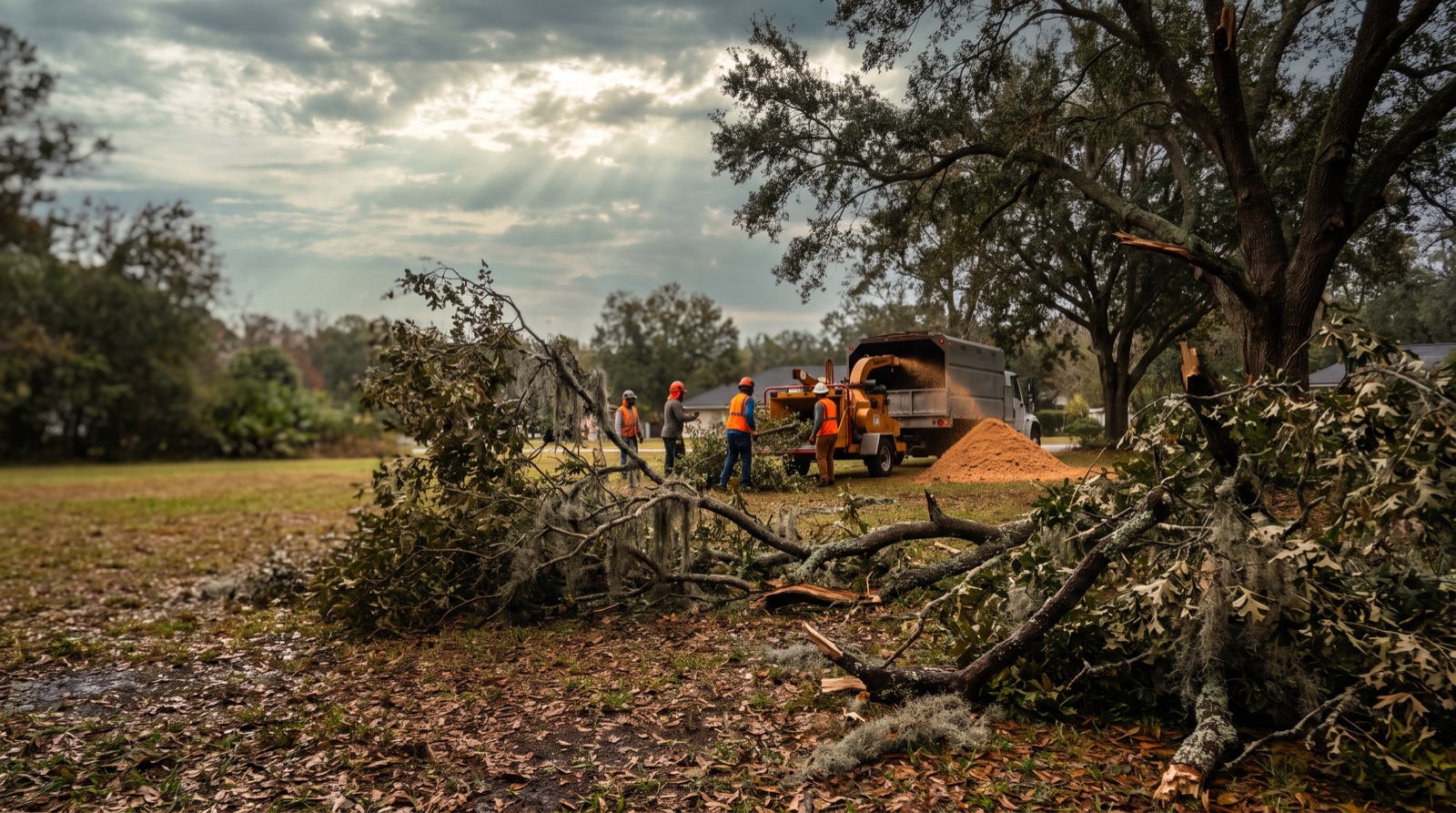
A complete storm cleanup is about far more than one fallen tree. Crews handle the whole scene:
- Trees off structures — safely lifting and removing trunks and heavy limbs resting on a roof, garage, carport, or fence, using a crane where access demands it.
- Hanging "widow-maker" limbs — broken branches lodged overhead that haven't fallen yet and will drop with the next gust.
- Split, leaning, or uprooted trees — trees that survived the storm but are now failing and have to come down before they finish the job themselves.
- Brush, limbs, and debris haul-off — the scattered wood and yard debris that turns a lawn into an obstacle course, chipped and carted away.
- Roof-area and structure clearance — clearing what's pressing on or overhanging the house so repair crews and adjusters can get in safely.
Hurricane season in Jacksonville
Jacksonville sits squarely in the hurricane belt, and the season runs June through November. What makes the damage worse here is the ground itself: the region's sandy, easily saturated soil gives big trees a shallow grip, so shallow-rooted slash pines and live oaks lean and topple in wind that a clay-anchored tree would ride out. Named storms like Matthew and Irma raked the First Coast in recent years and put thousands of trees down across Duval, Clay, St. Johns, and Nassau in a single night — and even the routine afternoon thunderstorms of a Florida summer drop enough limbs to bury a yard.
For typical prices on every service — removal, trimming, stumps, palms and storm work — see the full Jacksonville tree service cost guide.
Insurance claims: what's covered and how to document it
This is where a careful cleanup pays for itself. As a general rule, homeowners insurance covers tree removal when a storm-felled tree damages an insured structure — the house, garage, fence, or a vehicle — typically up to a per-tree or per-event limit written into your policy. What is usually not covered is a tree that falls in the open yard and hits nothing, or the preventative removal of a tree you're simply worried about. Because the whole claim often turns on proof, every job is documented: dated before-and-after photos and a written, itemized scope of the work. We document the scene and hand you the file — we don't act as your claims adjuster, and you're the one who files with your insurer. Keep your own photos too, and hold onto receipts. This is general information, not legal or insurance advice; your policy language and adjuster decide what's covered. For the acute, in-the-moment side of this, see emergency tree service.
After a storm, in order
Recovery goes smoothest when it happens in the right sequence:
- Make it safe first. Any active hazard — a tree on an occupied house, a limb over a walkway, anything near a power line — is handled before general cleanup. That's the emergency tree service call, and it comes first.
- Document everything. Before major cleanup begins, the scene is photographed and a written scope is written up so your insurance claim has what it needs.
- Full cleanup. Downed and failing trees come down, hanging limbs are cleared, and all the brush and debris is chipped and hauled away.
- Grind the stumps. Once the trees are gone, stump grinding removes what's left so you're not staring at a reminder in the yard.
Storm just came through the 904?
Get a licensed, insured crew out for a free assessment — and the dated photos and written estimate your insurer will ask for — before the post-storm rush fills up.
Call (904) 371-6603Prevent next season's damage
The best storm cleanup is the one you never need. Most of the trees that fail in a hurricane were showing warning signs long before the wind arrived — dead limbs, heavy one-sided canopies, decay at the base, or roots lifting out of that sandy soil. Pre-season pruning thins the canopy so wind passes through instead of pushing the tree over and clears limbs off your roof and lines. Where a tree is already compromised, hazard removal ahead of the season is far cheaper and safer than clearing it off your house afterward. Plan ahead with tree trimming and, for the trees that can't be saved, tree removal before June.
Serving the whole 904
Storm cleanup crews cover all of Duval County — Riverside, Avondale, Ortega, San Marco, Mandarin, Arlington, Southside, and the Beaches — plus Orange Park and Fleming Island in Clay, St. Johns, Nocatee, Ponte Vedra, and St. Augustine, and Fernandina and Nassau County. The mature-canopy neighborhoods with the biggest oaks and tallest pines tend to see the most storm damage — and the most cleanup work.