Riverside & Avondale's enormous moss-draped live oaks and tall pines need experienced, licensed and insured local crews for removal, trimming, stump grinding, and 24/7 storm work. Removals run about $500–$6,000+ (crane oaks at the top), trimming from ~$500; free estimates. Residential hazard removals need no city permit when an arborist documents it (HB 1159).
Riverside & Avondale's trees
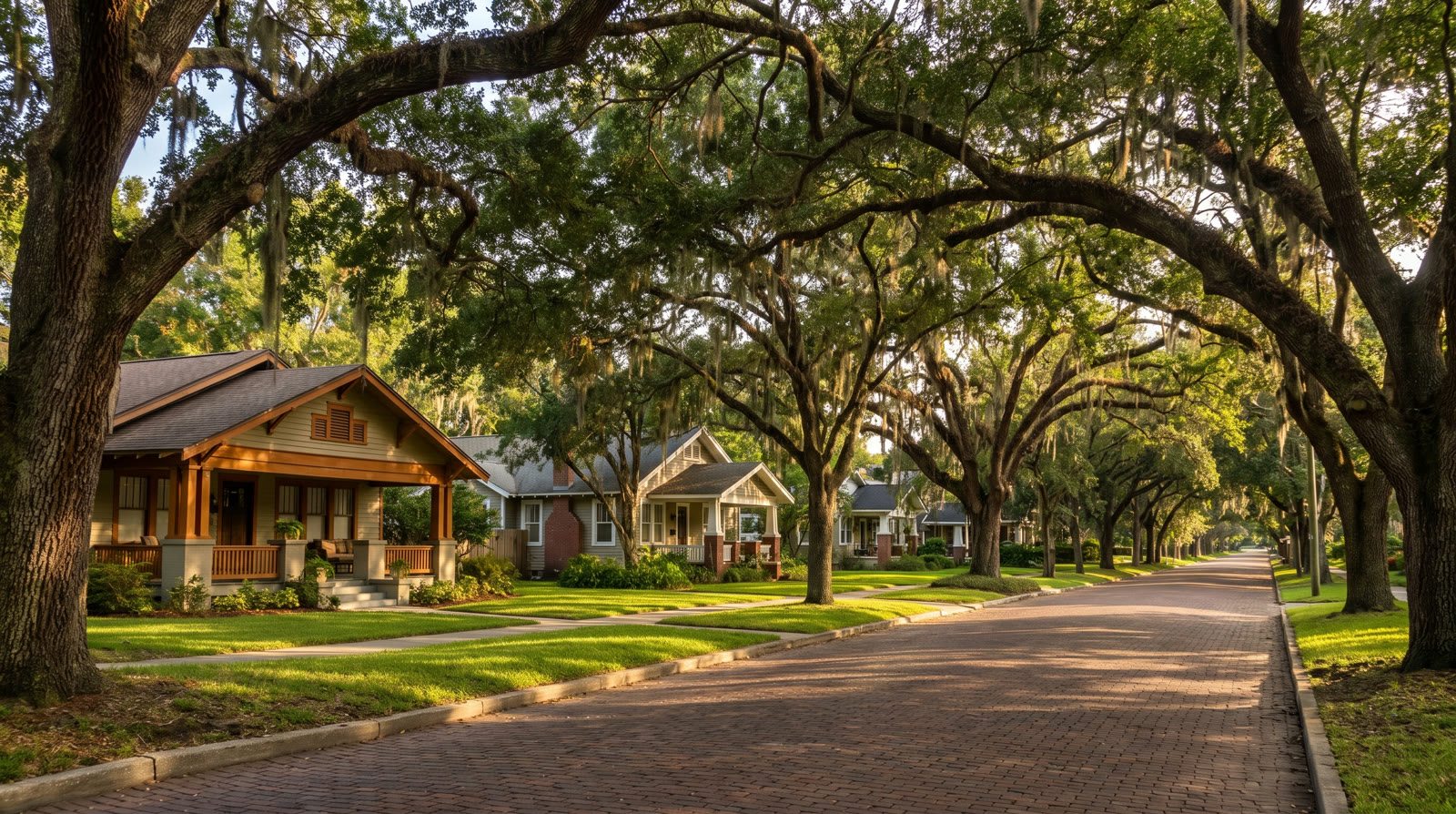
This is one of the most tree-defined places in the city. Riverside and Avondale hold some of Jacksonville's largest Southern live oaks — century-old giants with limbs that reach clear across the street, draped in Spanish moss and often underplanted with water oaks and laurel oaks that grew up in their shade. Between them stand tall slash and loblolly pines that tower over the rooflines. The housing stock is the other half of the equation: 1920s bungalows, Tudor and Mediterranean Revival homes, and brick-paved streets, most on narrow historic lots where a mature oak sits only feet from the house next door.
You see the canopy at its best around Memorial Park and Boone Park, where the oaks form a near-continuous cover, and all along the St. Johns riverfront where wind comes off the water. That density is exactly why the work here is different. When a big oak has to come down — or even get a heavy limb reduced — there's rarely room to simply fell it. Crews rig the wood in sections and lift it out, frequently with a crane, to clear it over close-set historic homes, power lines, and those irreplaceable brick streets without damaging anything below.
Tree services we cover in Riverside & Avondale
- Tree removal — from small yard trees to crane removal of the neighborhood's giant historic oaks.
- Tree trimming & pruning — deadwooding, canopy thinning, and clearance off roofs and lines.
- Stump grinding — grinding stumps below grade so you reclaim the yard; fast in the sandy soil here.
- 24/7 emergency tree service — around-the-clock response for trees on structures and blocked drives.
- Storm damage cleanup — full-property haul-off with photos and estimates for insurance.
- Palm tree service — trimming, skinning, and removal of cabbage and ornamental palms.
- Land & lot clearing — clearing overgrowth, fence lines, and lots for builds and additions.
These ranges hold across the 904 — for the full breakdown of what moves the number, see our Jacksonville tree service cost guide.
Storm season along the river
Riverside and Avondale sit right on the St. Johns, and hurricane season — June through November — is when the canopy becomes a liability instead of just a gift. The sandy, easily saturated soil near the river loosens its grip on shallow roots after days of rain, and the neighborhood's mature, top-heavy oaks and pines have a long way to fall onto historic roofs packed close together. The trees most likely to fail in a blow are usually the ones that have gone the longest without attention. The smart move is proactive: pre-season pruning to thin heavy canopies, reduce end-weight on long lateral limbs, and clear deadwood before the first named storm, so a strong tree stays standing instead of coming through a hundred-year-old roof.
Big oak leaning over the house?
Don't guess at a historic live oak from the ground. Get a licensed, insured local crew out to look at it — a free estimate now beats an emergency call in the middle of hurricane season.
Call (904) 371-6603Permits & insurance
Homeowners here often assume a historic-district address means a mountain of paperwork to touch a tree. For most residential work it doesn't. Under Florida HB 1159, a tree on residential property can be removed without a city permit when a certified arborist documents in writing that it's a hazard, and trimming or pruning needs no permit at all. Historic-overlay, commercial, and multi-family situations can carry extra review, so it's worth confirming before larger jobs — the full breakdown is on our Jacksonville tree permit page. On the insurance side, the rule of thumb is that homeowners policies cover removal when a storm-felled tree damages an insured structure — a roof, garage, fence, or car — but not a healthy or dead tree that falls in the open yard, and not preventative removal. Because it comes down to proof, crews document the scene with dated photos and a written estimate so you have what an adjuster asks for.